Sunday, February 23, 2014

São Jacinto gets flooded (February 21 – 22)


During these two days I assisted David Rodrigues with duck captures at São Jacinto, Portugal. The exceptional amount of rain that fell in Portugal during the past few weeks/months (as well as a dysfunctional drainage system due to the lack of proper maintenance) caused large parts of the Sao Jacinto reserve to flood. Reportedly, the water level has not been this high since 1995. Most of the lower trails around the pond were flooded, making our work very difficult. This is the main entrance to the reserve.

The trail to the field station, with a water level higher than my rubber boots.

Several of the oaks that I sowed near the pond last year were having a hard time too. Most will survive the flood, I suspect.

Following the rains is a massive outbreak of mosquitoes, making our work in the woods almost unbearable.

Due to the large amount of rainfall, surrounding areas currently are interesting for ducks as well, resulting in a relatively low number of ducks in the ponds of the reserve. At the same time the high water level caused the largest traps to largely disappear under water, meaning our trapping efforts were limited during this stay, as we could only operate a few of the smallest traps.
    
Common teals Anas crecca were most abundant; roughly 650 birds. We only managed to capture seven of these, which was a bit of a disappointment.
  
Regardless of the recent rains, the invasive acacia is currently flowering again as never before.

 
The ducks were still getting the attention of the Goshawks Accipiter gentilis. For them the breeding season has started, meaning the male now has to deliver prey to the female. I could enjoy several hunting hawks around the pond, flushing the ducks repeatedly. This made resighting teal saddles fairly easy, as many would otherwise remain hidden in the vegetation.

The puddles attracted large numbers of frogs; in particular Pelophylax (unidentified green frogs) were abundant, more abundant than there were ducks in the reserve.


During this stay I managed to record two new bird species for my São Jacinto reserve list: this Great Cormorant Phalacrocorax carbo was actively hunting and subsequently drying its wings in the pond, and a calling Carrion Crow Corvus corone, which flew over our heads at the field station.

Tuesday, February 18, 2014

The Peregrine eyries of Zwolle, The Netherlands


During the past few weeks I’ve been keeping a regular eye out for Peregrine Falcons Falco peregrinus above the city of Zwolle, The Netherlands. On February 12 I climbed the ‘Peperbus’ (‘Pepperbox’; a church tower in the city center) to inspect it for the presence of these falcons. After a renovation a few years ago, the tower got equipped with a nest box for this species, which thus far has not been used by the birds. I was lucky, as upon my arrival one peregrine perched on the tower.


To find out more about this bird’s status, I decided to pay a 2.5 Euro entrance fee to the tower and climb up to the observation level. Several meters above me the falcon (an adult female) was still scanning the horizon for prey. But when it saw me, it flew off immediately.


The bird flew off in the direction of an industrial area in the west of the city, just over 2 kilometers from the tower I was standing on. There a pair of peregrines is known to nest successfully in a nest box on a fodder factory/distributer ('Farmers/Hendrix') since 2012. I assume she was one of the breeding birds of that eyrie, but it spent the afternoon on the Peperbus to get a Feral Pigeon, which are abundant around the tower.

  
Also to the west of me, this couple of peregrines often perches on this tall real estate, which includes an ABN/AMRO Bank’s office.

The first known breeding pair of Zwolle nested in a nest box on this power plant (the two chimneys) in 2008. The site (4.5 kilometers south of me) has been occupied by falcons ever since, fledging chicks there almost annually.


The most recently established eyrie is located 4 kilometers to the northeast of me. There a pair of peregrines was seen on a large transmission tower (in the center back of this photo) for a first time in spring 2013.


While spring is in the air remarkably early this year, these falcons have regained interest in this transmission tower and have been seen there repeatedly during the past few weeks. Fabi managed to take this photo of the male of this pair, while it circled above us on January 26.


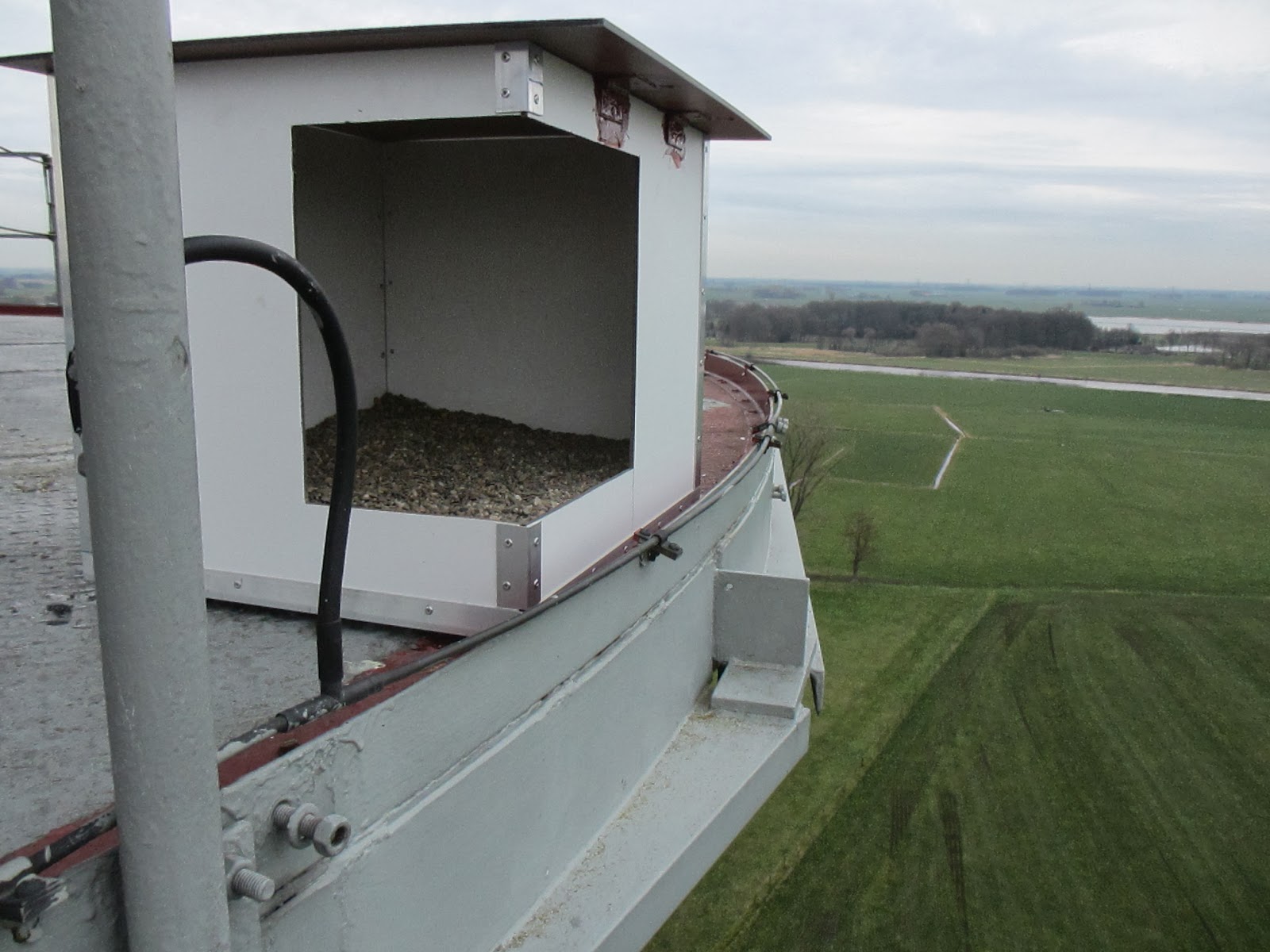
In order to better study and protect this pairs’ nesting attempts, recently a decision was made to install the fourth peregrine nest box for Zwolle on this tower. Today I assisted Jan van Dijk, head of the Raptor Working group Zwolle, with installing this new box. The tower is equipped with descent staircasing and even an elevator for materials, but drilling holes in a 0.8 cm thick metal sheet turned out to be quite a task.
 

Although much of it will have been swept or washed off the tower by the recent winds and rains, we found some evidence of the falcon’s presence on the tower, including a few peregrine feathers and a handful of prey remains.


The prey remains we found on and under the tower consisted of Racing pigeons (3 birds), Jackdaws (2), Stock dove (1), Eurasian Starling (1), Eurasian Woodcock (1), Black-tailed Godwit (1) and an unidentified tropical bird (1). All of the three official racing pigeon rings belonged to birds born in 2013 (the green rings) and probably all were taken by the falcons that same year.

 
Although one reason to install the nest box is to provide these birds a relatively safe and protected place to nest, signs indicated that at this location the falcons already had their eyes on a potential nesting ledge. There was no other option than to mount the nest box on the lowest of the tower’s three platforms (about 60 meters off the ground). About 15 meters higher the birds used the top of the staircase to get into the dark and weather protected entrance of the tower's observation level. Here the railing gets regularly used as a perch, as the steps and floor panels were covered with peregrine paint. Two corners contained a soft layer of old jackdaw nest material, as well as the pluckings of two jackdaws. If the falcons perch in this part of the tower, they probably cannot be seen from the ground. Time will tell whether the birds will prefer the magnificent view that the nest box provides over the ‘more natural’ Dutch eyrie.


View on the ‘Hendrix’ territory, apparently including the 'Peperbus', 4.5 kilometers to the south.


About 6.5 kilometers to the northwest of the transmission tower, Hasselt is located. Although peregrines rarely get reported from that village, its highest electricity pylons and church tower (in the far back on this photo) could provide an eyrie in the future?