Showing posts with label Eirol. Show all posts

Tuesday, February 17, 2015

Last gull rings to be read at the Eirol landfill? (February 17, 2015)


Today the landfill of Eirol got visited by Pedro Moreira and me for another day of gull ring-reading. Beforehand we got informed that certain measures were going to be taken to take care of the gull problem. These measures initiated yesterday. In about half an hour we managed to read four rings, all on Lesser Black-backed Gulls. Then a falconer made its appearance, together with two Peregrine falcons and a gas cannon.

 
Adult male Peregrine falcon.

 
Gas cannon

 
Panic
 

The first panic among the circa 4000 Lesser Black-backed Gulls and 300 Black-headed Gulls was caused by the falconer’s female Peregrine that got flown around the site for a short while. After this it was the gas cannon that made the gulls decide to abandon the site. We were later informed that the falcon had also flown away. Its gps signal indicated it already had made its way to the coast within a few minutes, probably faster than any of the gulls. In the end it was the gas cannon that made the gulls completely abandon the landfill.


Empty landfill...


Peregrine kill, but from Eirol's own falcon.


Regular blog readers will already have gotten used to the presence of a Peregrine falcon on the Eirol landfill (see previous posts). That bird already successfully reduced the number of Black-headed gulls at the site. During the past couple of weeks this now 2nd cy bird had remained faithful to the site. Today we searched for prey remains left behind by that falcon and found remains of another four Black-headed gulls. However, we did not see the bird itself. The last observation of it came from the falconer, who informed us that yesterday, after releasing his own Peregrine, our young falcon came to attack it and defend its feeding ground.

The current bird eradication program is planned to continue for two months. I suspect it will also keep out the Black kites from the landfill, which are supposed to arrive during the second half of February, and have already proven to be successful in reducing gull numbers to zero there during summer.

Tuesday, January 13, 2015

Eirol landfill, Portugal (January 12, 2015)


One of two adult Herring gulls Larus argentatus present at the site.


Herring gull number two.


Ringed Mediterranean gull Ichthyaetus melanocephalus, from Véron, les Prés Pendus, Yonne, FRANCE 48,07N 3,17E. One of two birds observed.


A Pied wagtail Motacilla alba yarrellii (top) and white wagtail M. a. alba (bottom).


The only signs of the young Peregrine falcon Falco peregrinus that resided at the landfill for some time (see previous posts) were 10 older remains of Black-headed Gulls Chroicocephalus ridibundus


...and, remarkably, the remains of a 1st winter Lesser Black-backed Gull Larus fuscus. Not a common prey for a Peregrine.

Thursday, December 4, 2014

Peregrine Falcon at the Eirol landfill: the story continues (December 3, 2014)


During recent visits to the landfill we were pleased to see the immature Peregrine Falcon Falco peregrinus (or hybrid?) was still around, putting some pressure on the Black-headed Gull Chroicocephalus ridibundus population. Recently, many new gulls have arrived from the north. The number of Black-headed Gulls increased to about 500 birds. Many of the new birds will have been unaware of the falcon’s presence. This will make them easy prey for the Peregrine, which is still operating from the top of the same Eucalyptus tree, aiming for the gulls that come to take a bath in the ditch below the tree. The ground around this ditch is currently littered with the remains of at least 9 Black-headed Gulls.


Among the new gulls that recently arrived at the site was this Black-headed Gull from Poland (White THPP).


The single Common Gull Larus canus were recorded on December 3, 2014.


It would be interesting to see how the Black-headed Gulls will deal with the presence of the falcon this winter. Since I’ve never visited Eirol in December there’s no data available about the number of gulls present at the site around this time. At the time the Taboeira landfill was still operational, during four visits in December 2011, I counted between 2500 and 5000 Black-headed Gulls...

Thursday, February 27, 2014

Gulls at the Eirol landfill, Portugal. February 26, 2014.


Due to other obligations and very poor weather conditions, the Eirol landfill had not been visited by me for a long while. Yesterday, there finally was a gap in the clouds. On this trip I got joined by Pedro Moreira. Pedro was particularly interested in the rarities that occasionally show up at the site, but as far as gulls went we did not record anything else then Lesser Black-backed -, Black-headed - and a few Yellow-legged gulls. There were plenty of gulls present; in particular the first two species were abundant. I was hoping to be able to visit the site before the first of this year’s Black Kites showed up, but we quickly found out that they were already there. We made a maximum count of 25 kites, which continuously flushed the gulls. According to personnel the first kites appeared around the 21st of this month. Between 7:15 and 16:45 Pedro and I managed to read 46 rings (44 LBBG and 2 BHG). This number could have been a lot higher if it weren’t for the dirt that covered many (about 40%!) of the rings, as well as for the time we spent talking with personnel of the site, and for the time we watched the impressive interactions between the gulls and the kites, making it a very nice day after all!


Here Fido, bring me the slipper.


Tuesday, September 3, 2013

Gull rings at the Eirol landfill, Portugal, September 3 2013


A waste of time at the landfill? Between 7:00 – 11:30 there were about 3250 Lesser Black-backed Gulls that visited the site. I highly suspect that the amount of exposed and delivered garbage has become a limiting factor for gull numbers. Only 23 rings were read this morning, which were applied in Guernsey (13), The Netherlands (3), Great Britain (4; excluding Guernsey), France (1), Norway (1) and Spain (1; Larus audouinii).


Larus audouinii


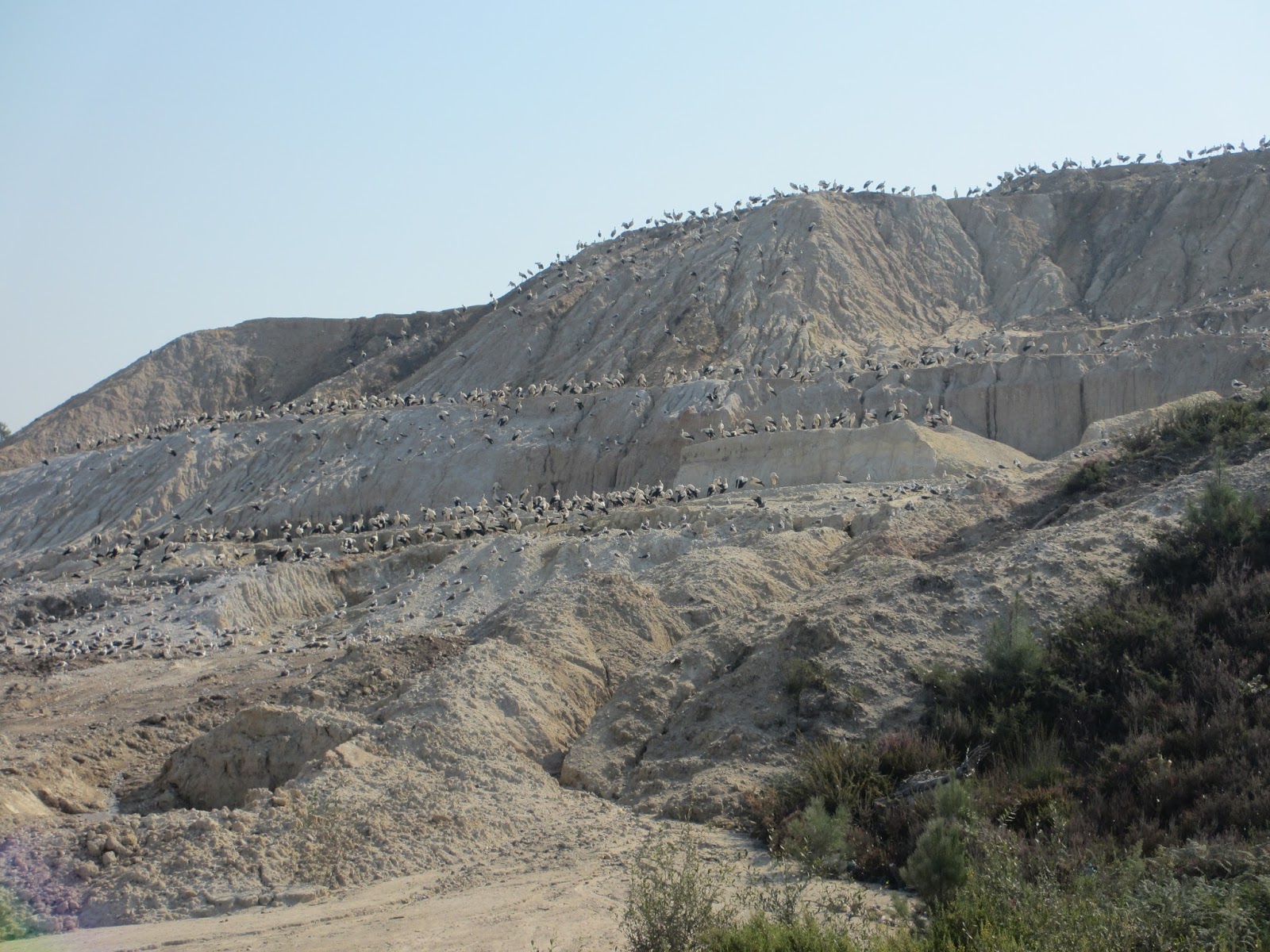
The only ring I could find among 550+ White Storks (bird in the middle). A dirty metal ring, placed on a tarsus.