During the past few weeks I’ve
been keeping a regular eye out for Peregrine Falcons Falco peregrinus above the
city of Zwolle, The Netherlands. On February 12 I climbed the ‘Peperbus’ (‘Pepperbox’;
a church tower in the city center) to inspect it for the presence of these falcons. After a renovation a few years
ago, the tower got equipped with a nest box for this species, which thus far has not been
used by the birds. I was lucky, as upon my arrival one peregrine perched on the tower.
To find out more about this bird’s status, I decided to
pay a 2.5 Euro entrance fee to the tower and climb up to the observation level. Several meters above me the falcon (an adult female) was still scanning the
horizon for prey. But when it saw me, it flew off immediately.
The bird flew off in the direction of an industrial area in
the west of the city, just over 2 kilometers from the tower I was standing
on. There a pair of peregrines is known to nest successfully in a nest box on a fodder
factory/distributer ('Farmers/Hendrix') since 2012. I assume she was one of the breeding birds of
that eyrie, but it spent the afternoon on the Peperbus to get a Feral Pigeon,
which are abundant around the tower.
Also to the west of me, this couple of peregrines
often perches on this tall real estate, which includes an ABN/AMRO Bank’s
office.
The first known breeding pair of Zwolle nested
in a nest box on this power plant (the two chimneys) in 2008. The site (4.5 kilometers south of me)
has been occupied by falcons ever since, fledging chicks there almost annually.
The most recently established eyrie is located 4 kilometers
to the northeast of me. There a pair of peregrines was seen on a large transmission
tower (in the center back of this photo) for a first time in spring 2013.
While spring is in the air remarkably early this year, these
falcons have regained interest in this transmission tower and have been seen
there repeatedly during the past few weeks. Fabi managed to take this photo of
the male of this pair, while it circled above us on January 26.
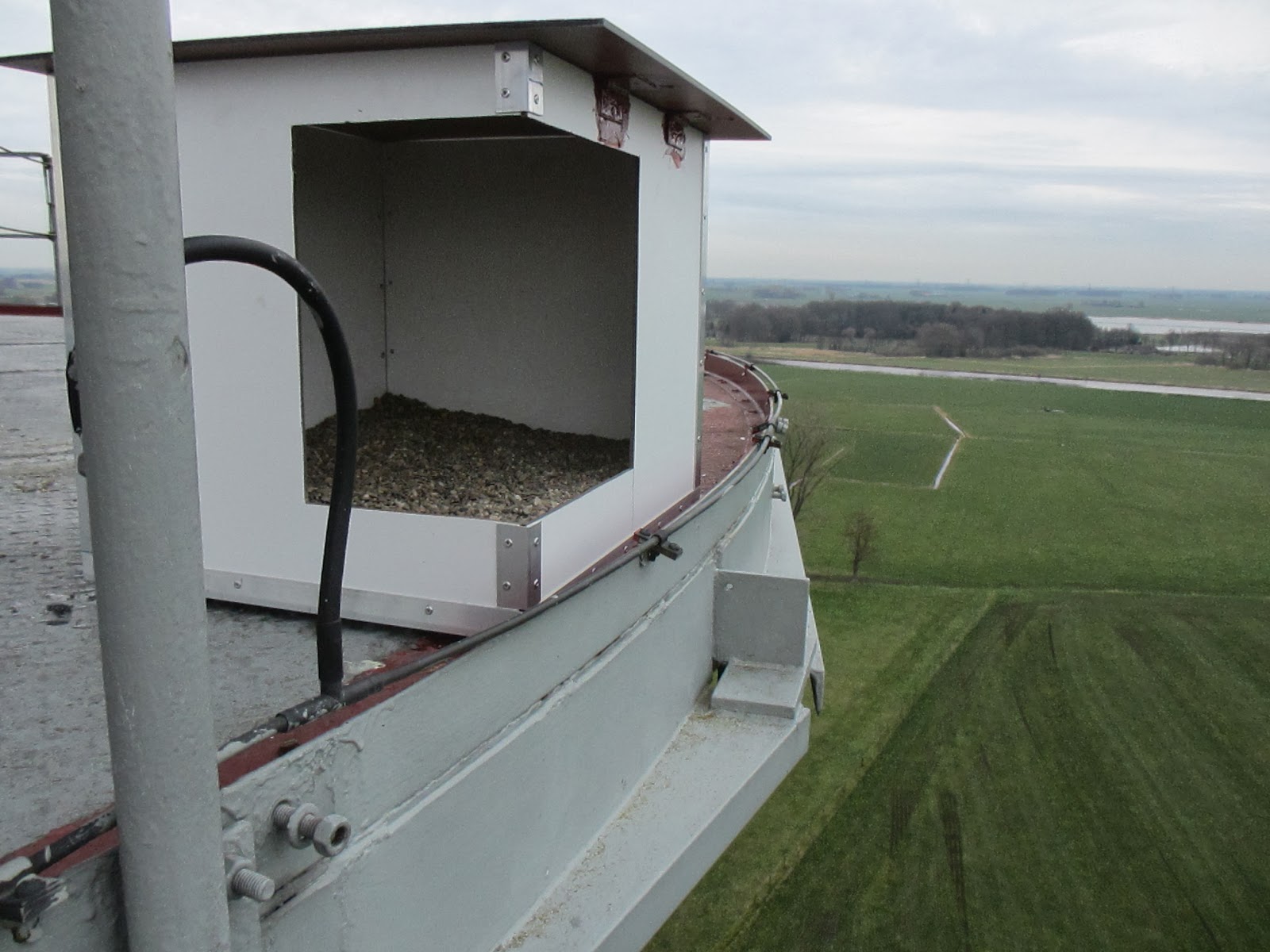
In order to better study and protect this pairs’
nesting attempts, recently a decision was made to install the fourth peregrine nest
box for Zwolle on this tower. Today I assisted Jan van Dijk, head of the Raptor
Working group Zwolle, with installing this new box. The tower is equipped with descent staircasing and even an
elevator for materials, but drilling holes in a 0.8 cm thick metal sheet turned
out to be quite a task.
Although much of it will have been swept or washed off the
tower by the recent winds and rains, we found some evidence of the falcon’s
presence on the tower, including a few peregrine feathers and a handful of prey
remains.
The prey remains we found on and under the tower consisted of Racing pigeons (3 birds), Jackdaws (2), Stock dove (1), Eurasian Starling (1), Eurasian Woodcock (1), Black-tailed Godwit (1) and an unidentified tropical bird (1). All of the three official racing pigeon rings belonged to birds born in 2013 (the green rings) and probably all were taken by the falcons that same year.

Although one reason to install the nest box is to provide
these birds a relatively safe and protected place to nest, signs indicated that
at this location the falcons already had their eyes on a potential nesting
ledge. There was no other option than to mount the nest box on the lowest of
the tower’s three platforms (about 60 meters off the ground). About 15 meters
higher the birds used the top of the staircase to get into the dark and weather
protected entrance of the tower's observation level. Here the railing gets regularly
used as a perch, as the steps and floor panels were covered with peregrine
paint. Two corners contained a soft layer of old jackdaw nest material, as well
as the pluckings of two jackdaws. If the falcons perch in this part of the
tower, they probably cannot be seen from the ground. Time will tell whether the
birds will prefer the magnificent view that the nest box provides over the ‘more natural’
Dutch eyrie.

View on the ‘Hendrix’ territory, apparently including
the 'Peperbus', 4.5 kilometers to the south.
About 6.5 kilometers to the northwest of the transmission tower, Hasselt is
located. Although peregrines rarely get reported from that village, its highest
electricity pylons and church tower (in the far back on this photo) could
provide an eyrie in the future?