Showing posts with label ringing. Show all posts
Monday, May 23, 2022
Sunday, June 18, 2017
Holes in a wall
Monday, June 5, 2017
Little ringed plover chicky
Sunday, May 21, 2017
Phylloscopus trochilus acredula
Wednesday, May 10, 2017
Training on Dutch andorinhas (May 10, 2017)
Sunday, September 27, 2015
Friday, September 11, 2015
Big Brown Bird
A 1st calender year Great Reed Warbler Acrocephalus arundinaceus. Caught, ringed, measured and released today in the wetlands of Salreu (Portugal).
Saturday, September 5, 2015
Aquatic warblers in Salreu
Aquatic warblers Acrocephalus paludicola are the rarest and the only internationally threatened passerine in mainland Europe. Apart from a very small remnant population in Western Siberia, its breeding grounds are completely confined to Europe. Drainage has meant that this species has declined. Its stronghold is now the south of Belarus, where 70% of the world's population breeds. This time of the year Aquatic warblers show up also in the wetlands of Salreu. These birds are on their way to Africa, where they spend the winter. They use the food rich marshes of Salreu to build up strength for the next part of their journey. JMN and I managed to ring two of these birds on September 4.
Typical Aquatic warbler habitat in Salreu: sedges and rice fields.
Wednesday, September 24, 2014
Creeps that only come out at night
Eurasian nightjar Caprimulgus europaeus, ringed on a very early morning of September 24 2014 at Salreu, Portugal.
See also: https://sites.google.com/site/juliomneto/blog & https://sites.google.com/site/juliomneto/ringing
Saturday, September 13, 2014
Ringing Yellow-crowned Bishops in Salreu (September 12, 2014)
Another early morning bird ringing-session in the marshes of Salreu, guided by Julio M. Neto. Results and more information can be found here: https://sites.google.com/site/juliomneto/blog/bishopgalore
The Yellow-crowned Bishops Euplectes afer originate from Africa and are considered invasive in the area. They are currently nesting (we trapped an egg-carrying female) and “pollute” our captures. Luckily, I find them quite easy to get out of the nets.
Tuesday, September 9, 2014
Great work on little brown jobs in Salreu, Portugal (September 8 & 9, 2014)
More information and the results of two enjoyable mornings of ringing in the marshes of Salreu with Julio M. Neto can be found here:
September 8: https://sites.google.com/site/juliomneto/blog/alatestart
September 9: https://sites.google.com/site/juliomneto/blog/onemorebritishrecovery
European stonechat Saxicola rubicola
Cetti's warbler Cettia cetti
Common waxbill Estrilda astrild
Bluethroat Luscinia svecica
Tree pipit Anthus trivialis
Sedge warbler Acrocephalus schoenobaenus
Weighing a ..?
Saturday, March 29, 2014
Monday, April 1, 2013
The Harculo power - and ringing station
On March 31st I visited the bird ringing station Harculo, located
in the gardens of a power plant, just south of Zwolle (The Netherlands). This ringing
station started in October 2012 and is being operated by some of my friends and
colleagues on a regular basis. The following birds were netted, measured,
ringed and released (with the number of recaptures in parentheses) during a
pleasant but early easter morning:
Great Tit Parus major
3(2)
Blue Tit Parus
caeruleus 2(2)
Common Blackbird Turdus
merula 3(1)
Long-tailed Tit Aegithalos
caudatus 4(0)
Common Chaffinch Fringilla
coelebs 3(0)
Eurasian Wren Troglodytes
troglodytes 1(0)
Greenfinch Carduelis
chloris 2(0)
White Wagtail Motacilla
alba 1(0)
We were working under the careful eyes of this Peregrine Falcon Falco peregrinus, which inhabits the power plant. Its mate currently incubates eggs in a nest box mounted in the top of a 60 meter high wall of the site.
An
adult Greater Black-backed Gull Larus
marinus at the cooling water inlet.
Tuesday, February 12, 2013
Lisboa M037213: The remarkable (but not unexpected) occurrence of a Mallard on a landfill and something about a hunter’s contribution to science.
As reported in the earlier blog entry about my most recent visit to the Eirol landfill (which I visit on a regular basis for gull ring reading and good overall birding - http://www.timvannus.blogspot.pt/2013/02/eirol-landfill-february-5-2013.html), an inspection of the present gull carcasses at the site resulted in the recovery of two metal bird rings. One originated from a BTO/British Lesser Black-backed Gull (for which I did not receive its life history’s data yet) and the other from an unknown species, though probably not a gull.
This particular metal ring (Lisboa M037213) was found on the bare sand of a yet unused part of the bottom of the landfill site. It was still attached to a (relatively short) tarsus and foot, of which the color of the flesh appeared to be orange. The ring itself was about the same size as used on the larger gull species. The whole set (leg and ring) had obviously been regurgitated by a gull at the spot, as it was lying among numerous other food remains at this gull roost.
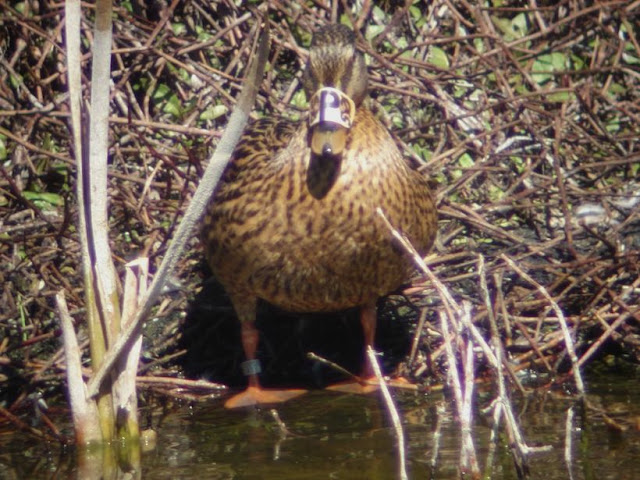
It did not take much effort to find out where and by whom this bird was ringed; the first birds with orange legs that came to my mind were ducks, so Portugal’s duck expert David Rodrigues (http://www.pt-ducks.com/) would be the right person to turn to. I help David on a regular basis with trapping, marking and monitoring ducks at the ponds of the Sao Jacinto reserve. As part of this ongoing project, captured duck are applied with a metal (Lisboa) ring and a unique nasal marker, allowing individual recognition of the released birds in the field, to study movements and migration, survival rates and fidelity rates to wintering grounds, as well as other aspects of duck bio-ecology.
In Portugal the annual survival of ducks is negatively influenced by widespread hunting activities. The idea is/was that when a hunter shoots a marked duck, he (or she??) will report the ring or saddle code, by which way insight is gained in the impacts of hunting on the duck populations. In the past some local hunting associations and their members have been informed about the existence of this project.
David recently informed me that M037213 had been applied on an adult female Mallard Anas platyrhynchos that was captured at the duck pond of Sao Jacinto on August 3, 2011. This bird was also given a nasal saddle with the code M0/Y/M0. It weighed 885 grams, had a wing length of 156 mm and was moulting primaries in the duck pond of Sao Jacinto. After its release that same day it was never resighted, neither recaptured.
When M037213 got prepared for the kitchen, most of its leg got cut off, as the tibia appeared to have been cut through just above its connection with the tarsus (probably with a knife). M037213’s leg and ring were thrown in a bin and ended up on the landfill, where they got swallowed by a gull, regurgitated in the pit, and eventually found there and reported by me.
I don’t believe not reporting a ring is considered a crime; it is certainly lame from my perspective. From a hunter’s perspective it may be acceptable to dispose the evidence that another duck had been shot. But for the least metals should be recycled. They should not end up in compost, but can be disposed in separate bins. Or maybe an example can be taken from Africa, where bird rings sometimes get reused for a necklace. Of course, the hunter still has the possibility of reporting the ring, but my confidence in the combination of hunting and science continues to decrease by the day.
|
Ring M037213,
as it was found at the Eirol landfill on February 5, 2013
|
This particular metal ring (Lisboa M037213) was found on the bare sand of a yet unused part of the bottom of the landfill site. It was still attached to a (relatively short) tarsus and foot, of which the color of the flesh appeared to be orange. The ring itself was about the same size as used on the larger gull species. The whole set (leg and ring) had obviously been regurgitated by a gull at the spot, as it was lying among numerous other food remains at this gull roost.
|
The yet largely unused open dump
site of the Eirol landfill, containing a large short term gull roost.
|
It did not take much effort to find out where and by whom this bird was ringed; the first birds with orange legs that came to my mind were ducks, so Portugal’s duck expert David Rodrigues (http://www.pt-ducks.com/) would be the right person to turn to. I help David on a regular basis with trapping, marking and monitoring ducks at the ponds of the Sao Jacinto reserve. As part of this ongoing project, captured duck are applied with a metal (Lisboa) ring and a unique nasal marker, allowing individual recognition of the released birds in the field, to study movements and migration, survival rates and fidelity rates to wintering grounds, as well as other aspects of duck bio-ecology.
In Portugal the annual survival of ducks is negatively influenced by widespread hunting activities. The idea is/was that when a hunter shoots a marked duck, he (or she??) will report the ring or saddle code, by which way insight is gained in the impacts of hunting on the duck populations. In the past some local hunting associations and their members have been informed about the existence of this project.
|
A marked and
studied female Mallard, wearing the usual outfit of one nasal saddle (in this
case S0/P/S0) and one unique metal ring.
|
David recently informed me that M037213 had been applied on an adult female Mallard Anas platyrhynchos that was captured at the duck pond of Sao Jacinto on August 3, 2011. This bird was also given a nasal saddle with the code M0/Y/M0. It weighed 885 grams, had a wing length of 156 mm and was moulting primaries in the duck pond of Sao Jacinto. After its release that same day it was never resighted, neither recaptured.
When M037213 got prepared for the kitchen, most of its leg got cut off, as the tibia appeared to have been cut through just above its connection with the tarsus (probably with a knife). M037213’s leg and ring were thrown in a bin and ended up on the landfill, where they got swallowed by a gull, regurgitated in the pit, and eventually found there and reported by me.
I don’t believe not reporting a ring is considered a crime; it is certainly lame from my perspective. From a hunter’s perspective it may be acceptable to dispose the evidence that another duck had been shot. But for the least metals should be recycled. They should not end up in compost, but can be disposed in separate bins. Or maybe an example can be taken from Africa, where bird rings sometimes get reused for a necklace. Of course, the hunter still has the possibility of reporting the ring, but my confidence in the combination of hunting and science continues to decrease by the day.
Subscribe to:
Posts (Atom)


